Italiano
 Deutsch
 Español
 Français

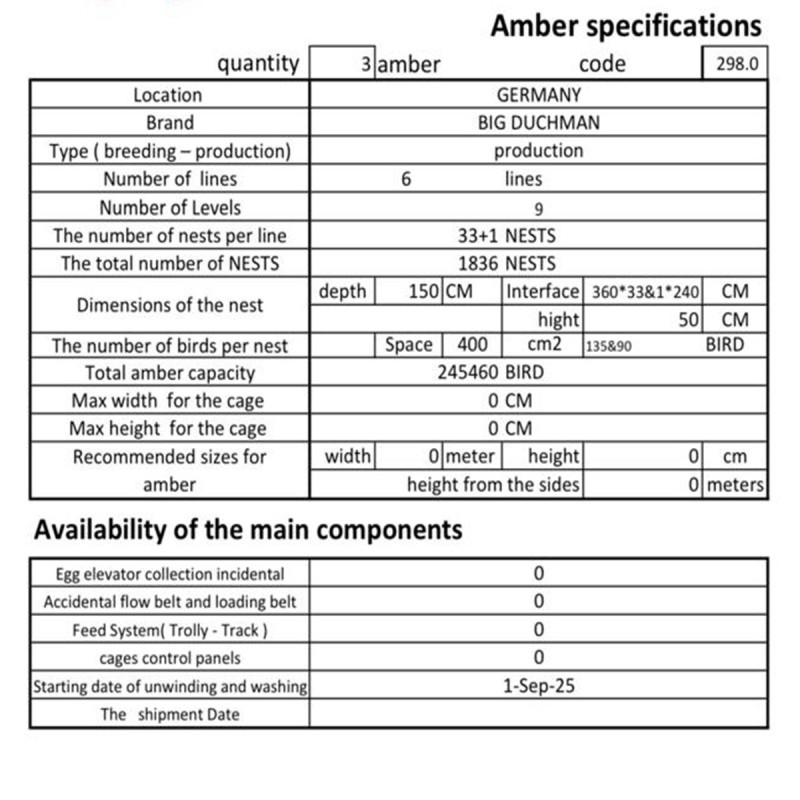
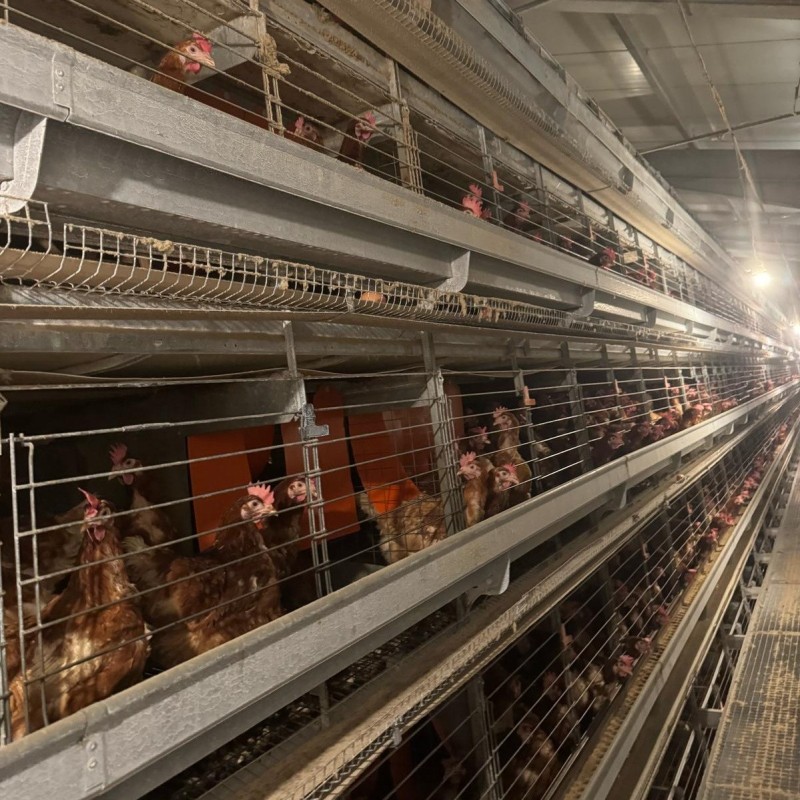
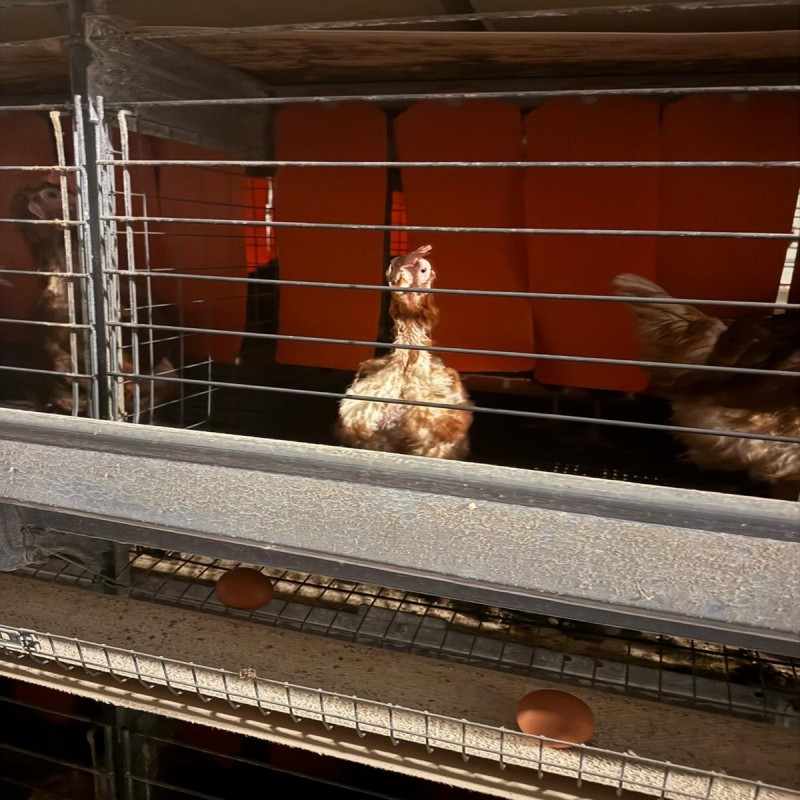
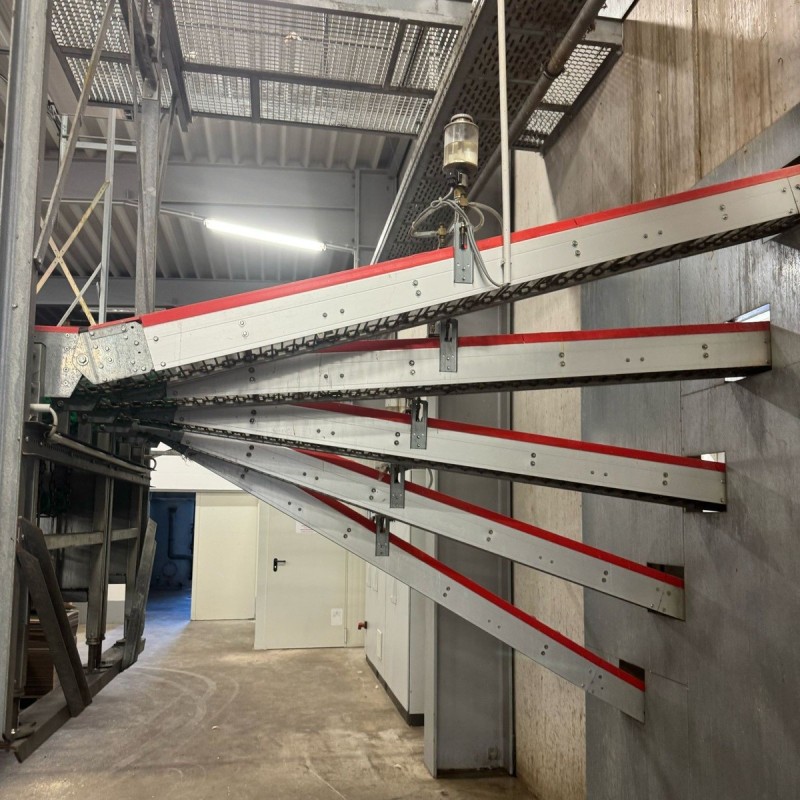
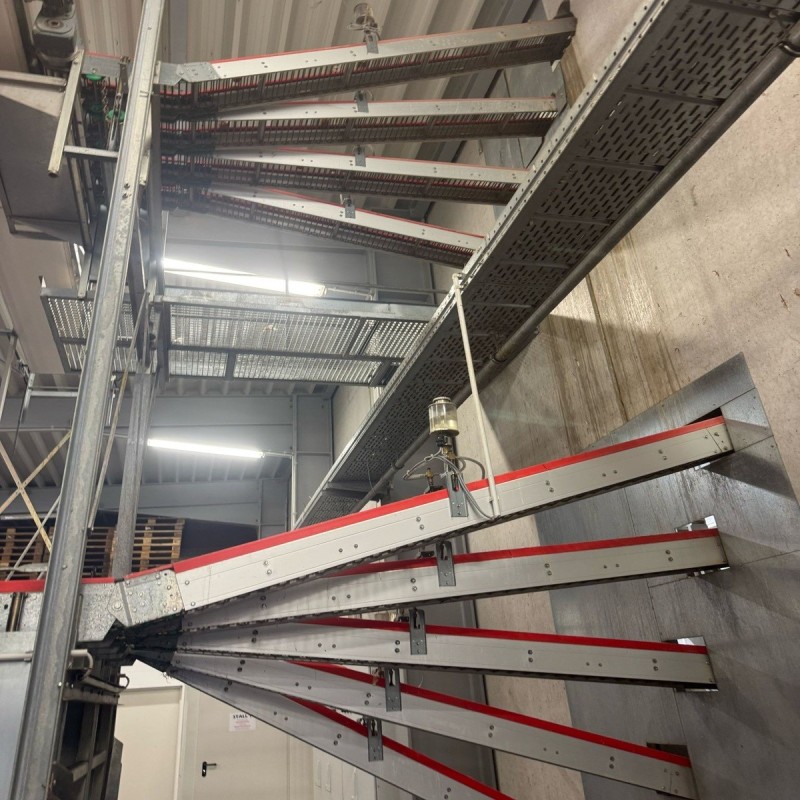
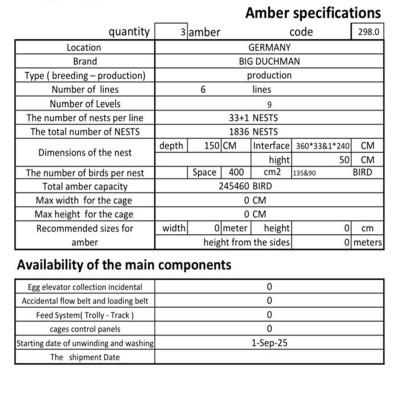
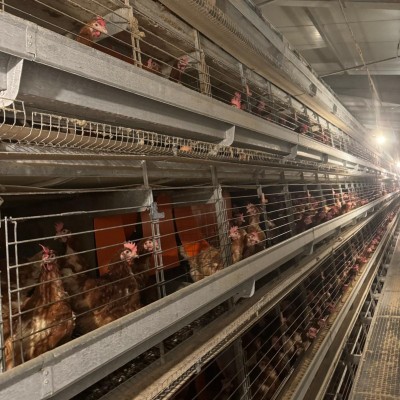
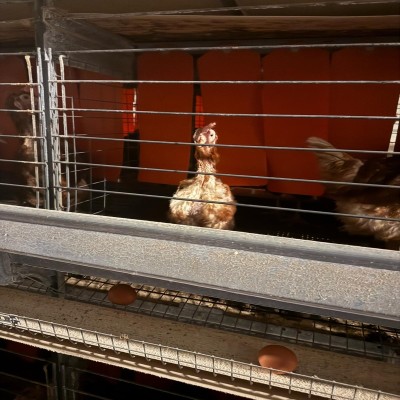
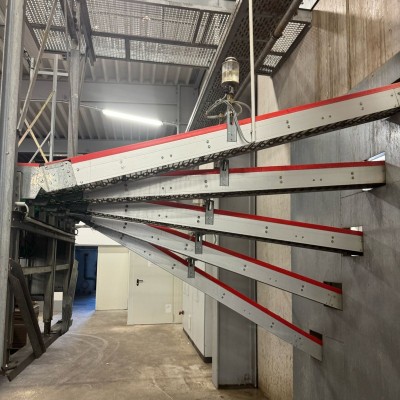
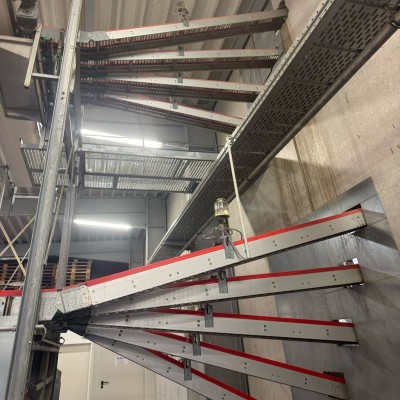
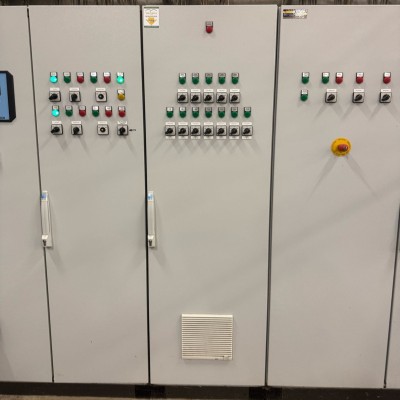
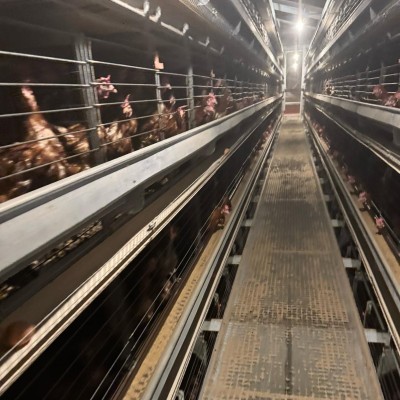
Location: Germany
Brand: Big Dutchman
Number of lines: 6 lines
Number of levels: 9
Number of nests per line: 33 + 1 nests
Total number of nests: 1836 nests
Nest dimensions:
Depth: 150 cm
Interface: 360 * 33 & 1 * 240 cm
Height: 50 cm
Animal load:
Nest space: 400 cm²
Birds per nest: 135 & 90 hens
Total capacity: 245,460 hens
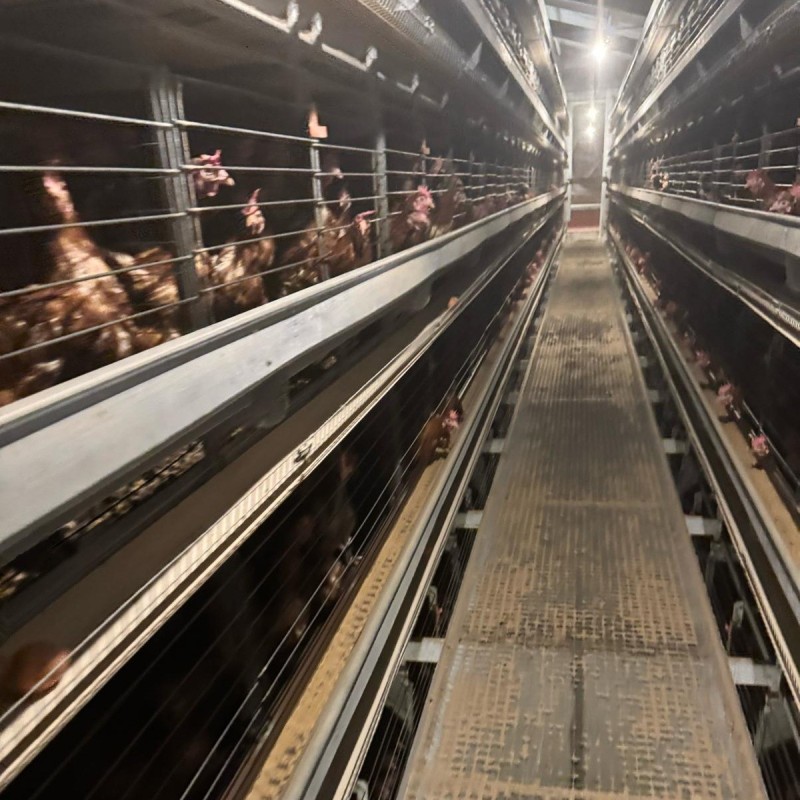
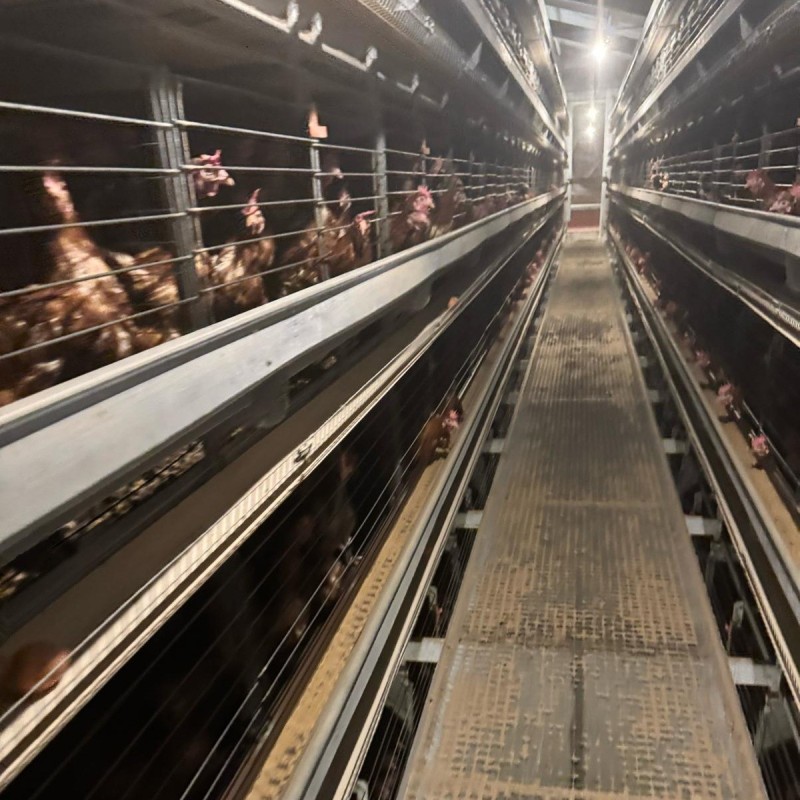
The Big Dutchman Amber system is a high-capacity, modular solution for intensive poultry production. Designed in Germany by the historic Big Dutchman company, which has been in business since 1938 and is a world leader in poultry technology.
With 6 lines on 9 levels and a total of 1,836 nests, this facility offers a total capacity of 245,460 hens , enabling large-scale breeding with great efficiency. Each nest has an area of 400 cm², with the possibility of housing up to 135-90 birds depending on the configuration—ideal for those seeking to maximize production while maintaining a minimum amount of space per bird.
The nests' dimensions (150 cm deep, 50 cm high) and multi-level layout allow for optimal use of vertical space, reducing floor space and simplifying the management of large numbers of birds. The system was designed with high productivity and simplified management in mind, in line with Big Dutchman's modern breeding technologies.
✅ High production density — with over 245,000 manageable animals, suitable for intensive and high productivity systems.
✅ Space optimization — multi-level structure and compact nests to reduce floor space.
✅ Reliability and know-how — Big Dutchman is globally recognized for the robustness of its systems and the protection of animal welfare.
If interested, request videos via WhatsApp at 3518819586
 SECURE PAYMENT METHODS
Cash on delivery, PayPal, credit card, in 3 installments, Satispay, bank transfer, Postepay top-up.
 SHIPPING COSTS
Italy offers free shipping on orders over €190. For smaller orders, shipping is €14.70 (place one order per Fiem-Borotto-River brand). European Union shipping is always €30.
 Free Consultation
Pre-purchase assistance to help you choose the product best suited to your needs, post-purchase support with usage advice and help finding spare parts.
Con ordini superiori a 190 euro, la spedizione è gratuita! Per importi inferiori, la tariffa fissa di una singola spedizione è solo 14,70 euro.
The system described is a large-capacity modular solution produced by Big Dutchman, a German company and world leader in poultry and swine technology.
With 6 lines spread across 9 levels and 1,836 nests , this system allows for intensive management capable of housing up to 245,460 layers — ideal for producers aiming for high volumes and space optimization.
High production density: thanks to the large number of rows/levels and compact nests, a large number of hens can be raised in relatively small spaces. This makes the system suitable for large-scale industrial or commercial settings.
Modular management and efficient structure: the modular configuration allows you to adapt the breeding scale based on demand — useful for those who need to gradually expand their business.
Reliability and proven expertise: Big Dutchman has been in business since 1938 and over the decades has established itself as a global benchmark for poultry and pig farming equipment, thanks to its quality construction, automation, and technical support.
Versatile: when combined with the right management systems (feeding, ventilation, egg collection, climate control), it can complement a modern and efficient production line. Big Dutchman offers a wide range of complementary solutions—feeding, watering, manure removal, and environmental control—to optimize animal health, welfare, and production performance.
It is important to consider that, in many countries (including the European Union), conventional cages for laying hens have been banned in favor of enriched or cage-free systems, for animal welfare reasons.
Over the years, Big Dutchman has adapted by offering alternatives—such as aviary systems and aviaries—that comply with regulations and improve the welfare of the hens.
Groups of breeders or companies operating on an industrial scale and seeking to maximize the number of layers per m² .
Situations where the priority is production efficiency, automation and compact management .
Structured projects that integrate feeding, air conditioning, egg collection, and waste management systems—to ensure operational efficiency and sustainability.
Local animal welfare regulations → ensure the facility complies with current laws (ban on conventional cages, minimum space per animal, accessible exercise areas, drinking and feeding facilities).
Need to invest in integrated systems (ventilation, feeding, egg collection, manure management) to ensure hygienic conditions and optimal productivity.
Careful monitoring and management of cargo: Higher density means greater attention to health, hygiene, and well-being.
Il pulcino per i primi dieci giorni non è in grado di autoregolare la temperatura corporea, e questa dipende esclusivamente dalla temperatura ambientale. Pertanto, anche brevi periodi di freddo possono essere letali. L’ambiente deve essere il più confortevole possibile evitando correnti d’aria e spifferi vari. La temperatura ottimale per il pulcino di 1 giorno è di 32 gradi circa. Chiaramente nei periodi freddi non tutto l’ambiente può essere tenuto a 32 gradi ma l’importante e che ci sia una zona con questa temperatura, ad esempio, sotto una lampada ad infrarossi o una chioccia artificiale. Vicino ci dovrà essere uno o più abbeveratoi e uno o più mangiatoie. Il tutto all’interno di un recinto per evitare che i piccoli si allontanino troppo. Importante che ci sia un buon isolamento tra pavimento e pulcini. La temperatura potrà essere abbassata di 2/3 gradi alla settimana per 5/8 settimane (dipende dalla stagione e dalla specie).
Il miglior termometro sono i pulcini, se si ammucchiano vuol dire che hanno freddo, se sono sparsi vuol dire che stanno bene, se vanno tutti lontano dalla fonte di calore vuol dire che hanno caldo
Nei primi tre giorni di vita è necessario garantire ai pulcini appena nati 21-23 ore di luce al giorno, che si riducono a 16 ore al giorno nelle successive tre settimane, e poi a 10/12 ore al giorno per garantire il corretto sviluppo degli uccelli.
Importante è o spazio a disposizione che deve aumentare nel tempo allargando il recinto. All’inizio 1 metro quadro è sufficiente per 40 pulcini. Dopo 2 settimane, servono 2 metri quadri sempre per 40 pulcini. Un sistema pratico è quello di aumentare di un metro quadro ogni settimana sempre per 40 pulcini
I pulcini devono avere sempre a disposizione del cibo asciutto, e acqua fresca. Vanno bene i mangimi commerciali specifici per età e specie che spingono molto l’accrescimento. Per rallentare l’accrescimento, per uno sviluppo più naturale, alcuni allevatori lo allungano con farine, frumento, mais spezzettato legumi ecc.
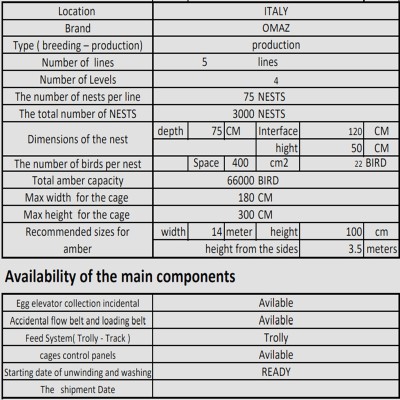
Location: Italy
Brand: OMAZ
Type (reproduction – production): production
Number of lines: 5 lines
Number of levels: 4
Number of nests per line: 75 nests
Total number of nests: 3,000 nests
Maximum cage width: 180 cm
Maximum cage height: 300 cm
This OMAZ system for 66,000 layers is a solution designed in Italy for farms requiring high efficiency, modularity, and maximum optimization of production space. The 5-line, 4-level structure, with a total of 3,000 nests , allows for orderly and scalable management of the farm, maintaining an adequate space-to-bird ratio thanks to the 400 cm² per nest and the compact dimensions of the laying stations.
The nest dimensions (75 cm deep, 120 cm wide and 50 cm high) are designed to ensure easy access for the hens and promote regular egg laying.
The cage can reach up to 180 cm in width and 300 cm in height, making it suitable for modern industrial warehouses. The recommended dimensions (14 meters in total width) help you properly plan the interior layout of the warehouse, ensuring adequate corridors, technical access, and ventilation.
If interested, request a video at 3355276060 with WhatsApp
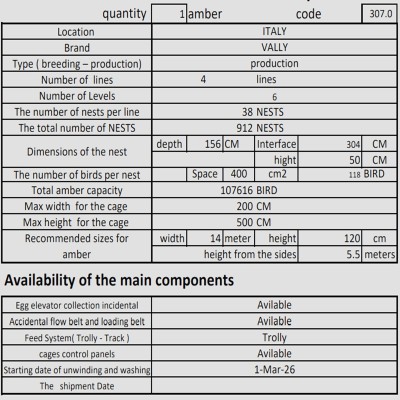
Location: Italy
Brand: VALLY
Type (reproduction – production): production
Number of lines: 6 lines
Number of levels: 4
Number of nests per line: 38 nests
Total number of nests: 912 nests
Nest dimensions:
• Depth: 156 cm
• Interface: 304 cm
• Nest height: 50 cm
Animal load:
• Nest space: 400 cm²
• Hens per nest: 118
• Total plant capacity: 107,616 hens
Structural limitations:
• Maximum cage width: 200 cm
Main components:
• Egg collection elevator: Available
• Flow belt / loading belt: Available
• Power supply system: Trolley
• Cage control panels: Available
• Start date of execution and washing: 1-Mar-26
• Shipping date: not indicated
This VALLY system for 107,616 layers is an Italian solution designed for large farms requiring very high production capacity and a robust modular structure. With 6 lines on 4 levels and 912 nests , the system is designed to support intensive production flows, maintaining order, accessibility, and a high number of birds per unit. Each nest offers 400 cm² and houses up to 118 hens , a fact that highlights the system's high density and its intended use in large-scale installations.
The nests' dimensions (156 cm deep and 304 cm wide) facilitate the collection and management of the layers, while the low height of 50 cm contributes to the compactness of the structure. The cage has a maximum width of 200 cm, a feature that allows the system to be integrated into sheds with standardized spaces.
If interested, request a video via WhatsApp at 3518819586